

.svg)


Pressing and extrusion equipment for processing sunflower seeds of own production
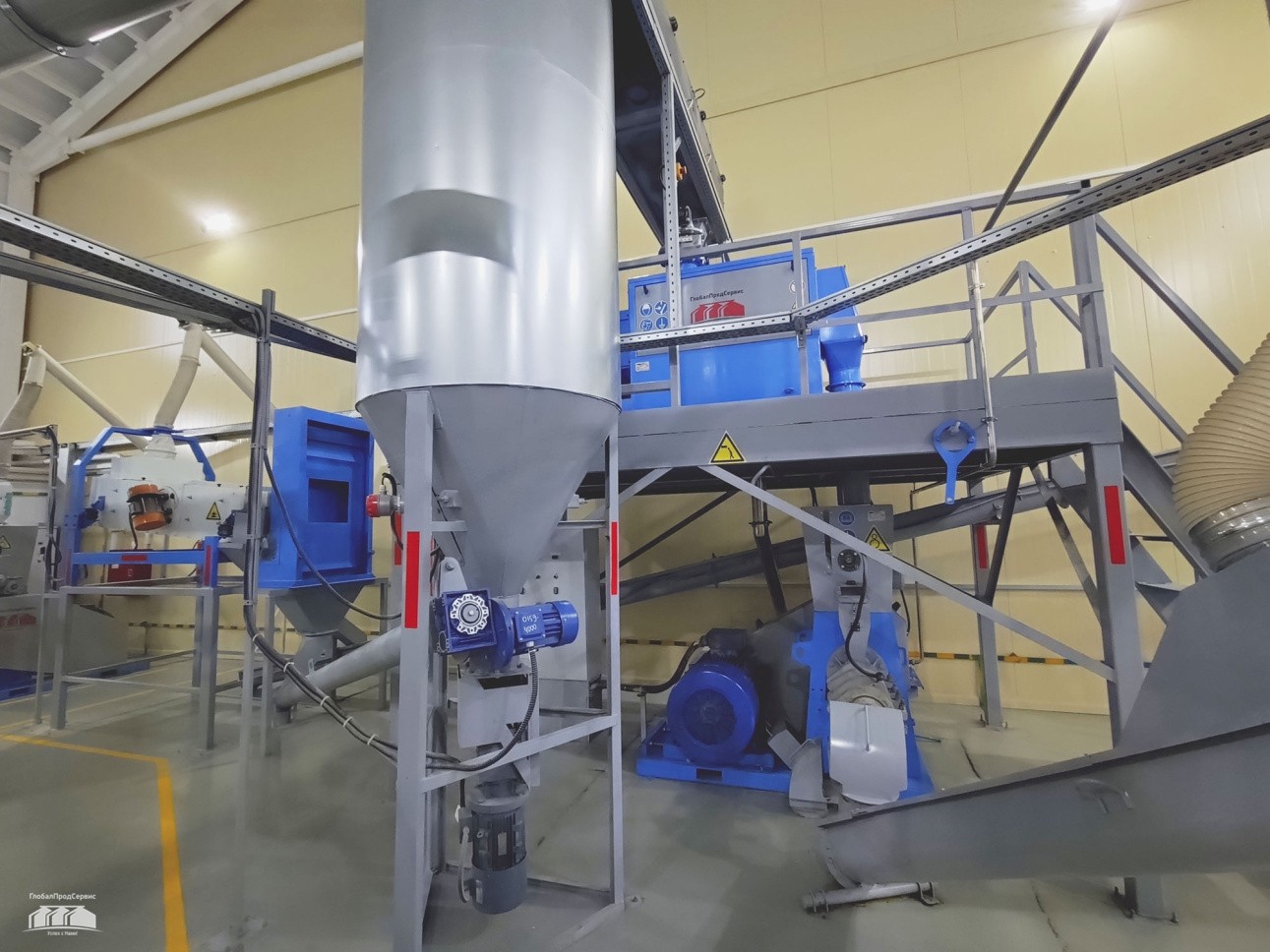
Sunflower is one of the main oilseeds cultivated in the world. The main purpose of its cultivation is to obtain and widely use vegetable oil, which is of great economic importance not only in the production of seeds, but also in their subsequent processing. Moreover, in the context of the growing development of animal husbandry and poultry farming, the use of sunflower seed processing products – oilcake and meal for the production of compound feeds are in great demand in these industries.
Universal technological solutions from Globalprodservice
Along with existing and under construction new oil extraction plants, there is a demand for mechanical processing of oilseeds among large enterprises and farms. Such processing is based on environmental safety, since the technology does not use chemicals, as well as versatility, i.e. the ability to process seeds of various oilseeds using the same pressing equipment.
Globalprodservice offers several technologies and a range of pressing and extrusion equipment for on-farm processing of sunflower seeds, focusing on solving those technological schemes for which there are requests from customers.
1. Sunflower processing technology: SINGLE-STAGE COLD PRESSING
When deciding on the production of low-tonnage equipment for processing sunflower seeds using one- to two-stage cold pressing technology, we took into account the technological feature of such processing - the minimum number of production operations and, accordingly, equipment. In this case, the processing of seeds by the cold method included only three stages - cleaning the seeds, pressing them and filtering the cold-pressed oil.
The simplest and most budget-friendly version of a low-tonnage farm unit for single-stage cold pressing of sunflower seed oil with a capacity of up to 500 kg/h for input raw materials includes the following equipment:
- oil press GL-RP-500,
- oil collection tank GL-G
- the first screw conveyor is for feeding seeds to the press
- the second screw conveyor is used to remove the cake outside the press shop.
Sunflower seeds without any preliminary preparation (crushing, collapsing, heating) are sent by a screw conveyor directly to the oil press, where the oil is pressed. Such a fairly simple technology and equipment make it possible to process not only sunflower seeds, but also other oilseeds, which increases the profitability of a farming enterprise.
It is known that when pressing unbroken seeds, some of the wax from the husk inevitably turns into oil, therefore, such oil, used for food purposes, must go through the stages of freezing and filtration. The critical parameters of the cake obtained from unbroken sunflower seeds in comparison with the cake obtained from crushed seeds are a lower protein content with a higher fiber content. Such a cake has a correspondingly lower feed value and cost. However, if this sunflower cake is used by the farmer for his own feed needs, then he can adjust or compensate for the protein and fiber content in the feed with other grain components.
Based on many years of production experience in the field of sunflower seed processing, it can be stated that when processing unbroken seeds on low-capacity presses, it is possible to achieve a good percentage of oil extraction, and there will be no major problems with husk disposal. However, the main negative operational factors of processing unbroken seeds will be accelerated wear of press parts due to the high abrasiveness of sunflower husks and increased load on the auger, gearbox and electric motor of the press.
Globalprodservice reserves the right for the client to choose whether or not to purchase additional, rather difficult to set up and expensive crushing and winnowing equipment (RVO) for processing sunflower seeds on presses with a capacity of up to 500 kg/h.
In sunflower seed processing lines with a capacity of 1000 kg/h or more, the company recommends that the technological scheme include a crushing and winnowing equipment for crushing seeds and removing husks.
2. Sunflower processing technology: DOUBLE HOT PRESSING
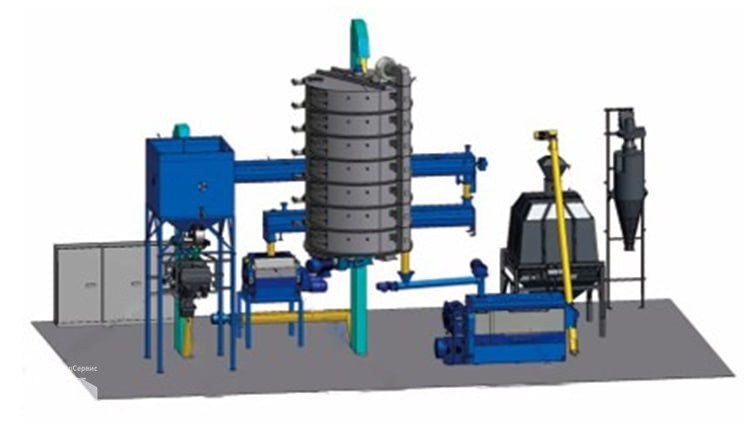
As an example of the processing of sunflower seeds using hot-pressing technology, we can cite a line with a capacity of up to 50 tons per day, which includes the following set of operations:
- preliminary preparation of seeds
- peeling
- heat treatment in multi-pan braziers
- oil extraction by double hot pressing
The output of the technology will be vegetable oil and hot-pressed cake.
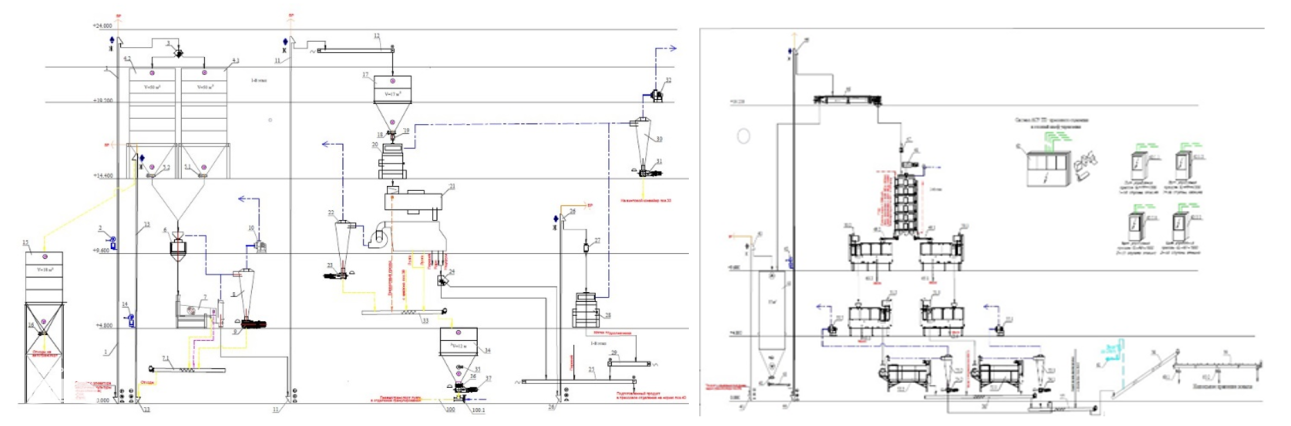
The process of processing seeds by hot pressing is implemented as follows. Sunflower seeds that have been pre-cleaned at the separator are fed into an operational tank with a volume of 12.5 m3, from which they are fed to the crushing and winnowing equipment (RVO) where the sunflower shell is collapsed from the core and the husk is extracted from the collapsed sunflower seeds.
The purpose and significance of sunflower seed collapsing
It should be noted that the crushing of sunflower seeds is an extremely important prerequisite for achieving high oil extraction efficiency by pressing. Moreover, the positive effect of the partial collapse of sunflower seeds on the RVR is manifested primarily in the quality of the oil by reducing the wax content in it. However, when the degree of seed collapse is increased to 100%, i.e., obtaining a pure sunflower kernel, oil extraction will be more problematic in terms of its technical implementation on screw presses. Therefore, the optimal percentage of husk removal from the initial content (total weight) is We recommend it in seeds at the level of 50...70%.
It is well known that seed crushing has a significant impact on the quality of the resulting cake - an increase in protein content and a decrease in fiber content. Moreover, according to GOST 80-96 and the requirements of the current TNPA of the Republic of Belarus, the mass fraction of crude fiber in sunflower cake should be no more than 20% in terms of a.s.v.
As follows from the production practice of processing sunflower seeds by pressing, the husk is not only a ballast and a by-product after the seeds collapse, but a very important component of the pressing process, which contributes to the formation of a rigid porous frame in the pressing chamber from the collapsed seeds and the husk remaining on them, which leads to the creation of a certain pressure in the press necessary for pressing oil and its draining through the channels formed in the cake.
Our practical recommendation is that in the process of processing sunflower seeds with different percentages of husk content and varying degrees of collapse, we should strive to find the optimal husk content after the seeds are collapsed, which would ensure stable operation of the presses to maximize the yield of high-quality oil, as well as increase the feed value of the cake.
After collapsing, the resulting mixture, called rushanka, enters the seed machine and, after passing through the sieving, is divided into six fractions, of which five enter the sieving, and the sixth is removed from the machine, bypassing the drying. Each of the five fractions of the product delivered to the dryer enters the chamber intended for it, where the product is screened with an air stream and the husk is separated from the core by the difference in aerodynamic characteristics. After drying, the husk is removed by a screw conveyor into a waste bin.
The collapsed and cleaned seeds are fed by screw conveyors to the burrow, which transports them to an operational hopper with a volume of 24 m3, designed to accumulate seeds and ensure uninterrupted operation of the pressing compartment.
From the operational hopper, the collapsed seeds are fed by a screw feeder to the burrow, which moves the raw materials to a chain conveyor and is then transported to a five-chamber roaster (210x5) for heat treatment. The heated raw materials are fed through the outlet windows from the brazier using screw feeders to the GL-RP-1000 oil press for primary pressing.
The pressed oil seeps through the gaps of the seed chamber and flows into the GL-G oil collection tank located under the press. The cake is discharged from the press through a conical sleeve, the opening of which is adjusted by a cone and special screws, which allows you to change the oil content of the cake by 1-2%. A cake grinder is installed under the cone, which grinds the cake into pieces for faster cooling, preservation of protein quality and ease of transportation. Then the cake is fed by screw conveyors to the hole, and after it it is moved by a screw conveyor to a five-hole roaster (180x5) for the next heat treatment before the second pressing. The cake heated in the roaster is transported through the lower discharge windows using screw feeders to the GL-RP-1000 oil press for final pressing. The cake coming out of the press is moved by screw conveyors for its subsequent cooling at the GL-OE-1000 installation, and then to the finished product warehouse.
Oil filtration and storage
The oil pressed on two presses is collected into a GL-G oil collection tank, and then pumped into a GL-TA oil primary storage tank. The GL-TA tank simultaneously serves as a storage and operational tank for the oil filtration process on the GL-LF filtration line. Unfiltered oil from the GL-TA tank is pumped into the GL-VPLF vertical filter. The oil filtration in the vertical filter is carried out through a set of vertical steel plates. The filter housing is opaque, but the oil condition can be monitored using three special plexiglass lights that are integrated into the supply and outlet pipelines.
In the filtration line, all filter elements, all containers and other parts in contact with oil are made of food-grade corrosion-resistant and acid-resistant AISI 304 stainless steel. The use of steel ensures excellent filtration results and long-term operation, with a service life of about 5 years for filter elements. No additional filtering materials, powders, etc. are used in the filtration process.
The filtered oil is pumped through scales designed for pre-weighing and controlling the amount of oil, using a pump, into oil storage tanks, from which it is subsequently pumped to vehicles.
3. Sunflower processing technology: TWO-STAGE PRESSING WITH EXTRUSION
Along with the processing of sunflower seeds by hot pressing, the company focuses on the production of modern lines that implement the technology of two-stage pressing with extrusion according to the scheme: press + extruder + press. This processing technology makes it possible to obtain two types of oils - cold and hot pressed and extruded oil cake. Moreover, the oil output is comparable to the oil output during hot pressing.
We offer processing lines with different capacities - up to 500 kg/h – GL-B-500 line, up to 1000 kg/h - GL-B-1000 line. Moreover, depending on the required annual volume of seed processing, a multiple scaling of the number of production lines in terms of productivity is possible.
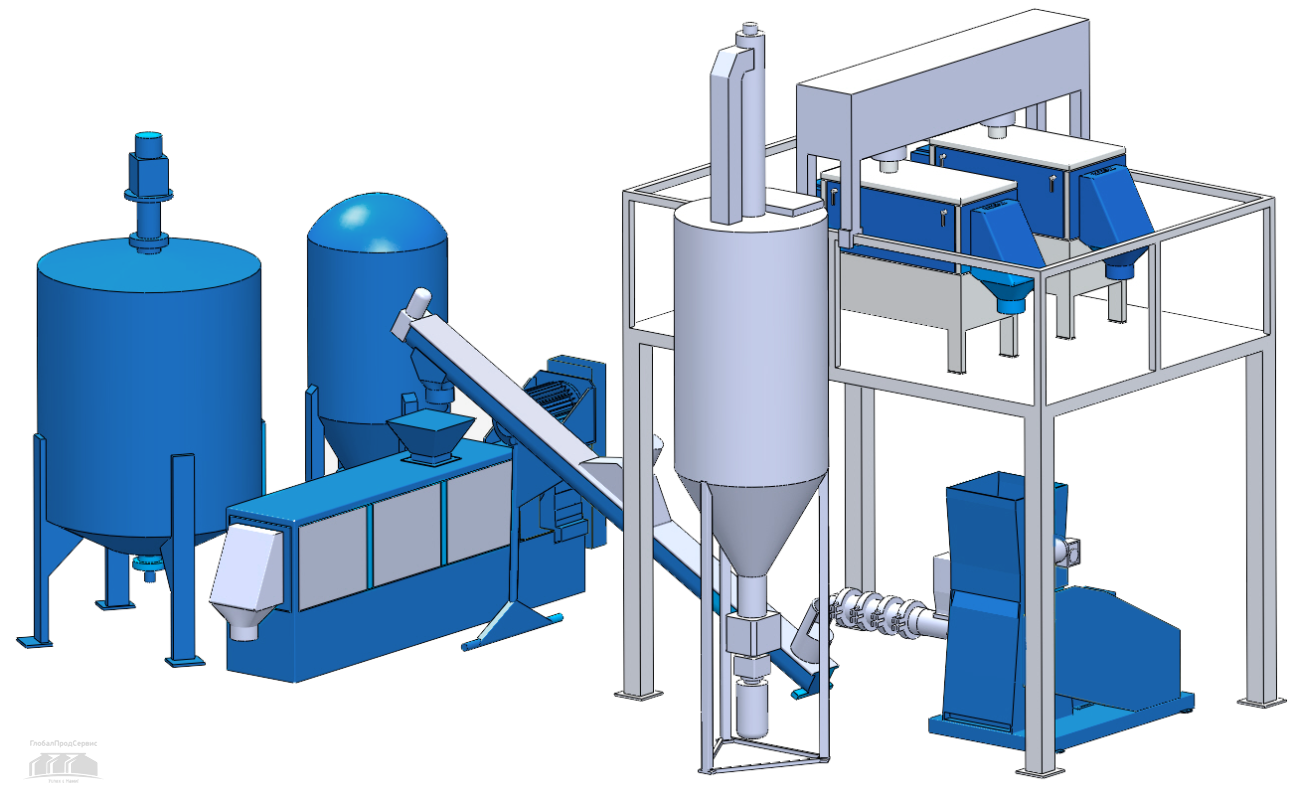
Two-stage pressing line with extrusion up to (up to 500 kg/h)
The sunflower seed processing line with a capacity of up to 500 kg/h includes the following equipment:
- seed pre-cleaning separator,
- active storage hopper, 5.4 meters high,
- normalizer for heating seeds and improving oil extraction on the pre-press,
- magnetic separator,
- oil press GL-RP-500 for the 1st stage of pressing,
- extruder GL-E-500,
- oil press GL-OP-500 for the 2nd stage of pressing,
- oil cake cooling unit GL-OE-1000 (with cyclone, airlock and fan)
- oil filtration department (includes an oil collection tank with a GL-G agitator and a pump, a vertical pressure plate filter with a pump, oil scales, a tank for primary oil accumulation, a tank for storing and releasing oil in a insulated jacket with an oil pump and a pump for pumping oil into vehicles for shipment or storage oil).
All the equipment for seed processing is connected by transport routes from screw conveyors.
Two-stage pressing line with extrusion up to (up to 1000 kg/h)
Let's take a closer look at the technological process of processing sunflower seeds using two-stage extrusion technology with a capacity of up to 1000 kg/h.
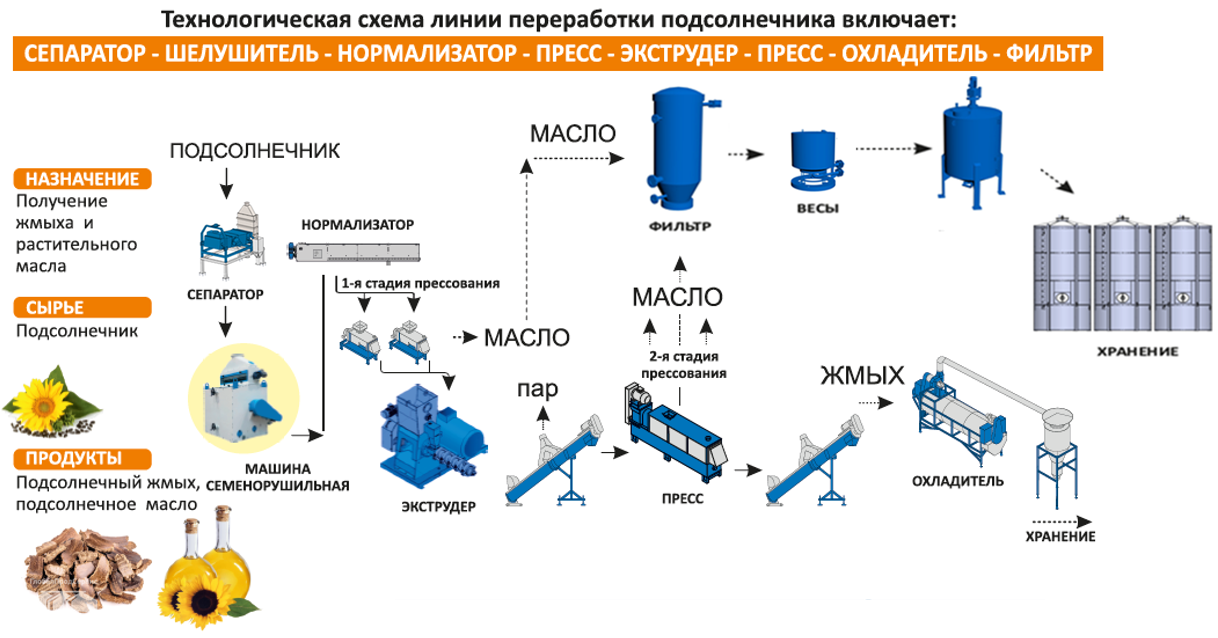
From the storage, sunflower seeds are fed using screw conveyors to the preparatory compartment, from which the seeds are sent by a vertical screw conveyor for pre-cleaning to a separator, where they are cleaned of large and small weeds on two pairs of sieves arranged in parallel in the sieve housing.
Then sunflower seeds are fed by a screw conveyor through a magnetic column to a centrifugal husker with a capacity of 1.5 t/h. After the collapse of the rushank, a screw conveyor is sent through the active storage unit to the HP-2 normalizer, which warms the seeds to about a temperature of + 35 °With the possibility of its adjustment using the automated process control system.
The heated seeds are fed by screw feeders and through a magnetic separator into the loading bins of two GL-RP-500 presses, where up to 45% of the total volume of oil contained in the seeds is squeezed out.
Cold-pressed oil flows into the collection chamber created by the elements of the press frame, and then through a nozzle in the lower part of the press it is discharged into a container for collecting the pressed GL-G oil. At the outlet of the presses, the cake is crushed by an impeller and sent to the GL-E-1000 extruder, where it is subjected to short-term and intense barothermal action. During the extrusion process, the cake is crushed, mixed, heated by friction and compacted when it is moved by screws, and then squeezed out through the nozzle of the extruder at high pressure. As a result of extrusion, fat cells are destroyed (ruptured), which, during subsequent pressing, increases the amount of pressed oil.
After the extruder, the hot extrudate is fed using a screw conveyor to the GL-RP-1000 oil press for final pressing. Moreover, the design of this screw conveyor has a hatch with a pipe for steam extraction and discharge by a special corrosion-resistant fan through an aspiration network outside the press shop. The removal of hot wet steam helps to reduce moisture in the extrudate, which allows the press to work more efficiently to extract the remaining amount of oil.
The oil flows through the gaps of the seed chamber of the press into the collection container GL-G located under the press. The extruded cake is discharged from the press through a conical sleeve. A cake grinder is installed under the cone of the press, which grinds it into smaller parts for easy transportation and for rapid cooling in the GL-OE-1000 cooling unit. The cooled cake is fed by screw conveyors to the finished product warehouse.
The oil obtained during pressing is pumped from the GL-G oil tanks into the GL-TA oil storage tank. Unfiltered oil from the tank is pumped into the GL-VPLF filter of the GL-LF filtration line, in which oil filtration and removal of the sludge layer from the filter are carried out automatically.
The filtered oil is pumped through scales designed for pre-weighing and controlling the amount of oil, using a pump, into oil storage tanks, from which they can later be released into vehicles by a pump. The resulting unrefined oil corresponds to the grade "R" grade 1 according to STB 1486, and according to GOST 1129-2013 – the Highest or First grade.
The company produces filters of various capacities, the size of the filter housing (working volume) and the number of filter plates installed in it (filtration area).
In some sunflower seed processing plants, the husk obtained after collapsing is additionally granulated. This operation allows you to reduce the volume of the husk during its storage and transportation. In addition, pelletizing husks into pellets allows them to be used or sold as a fuel source for boilers. The company has suitable crushers and press granulators for sunflower husk granulation.
Automatic process control system
The above oilseed processing lines are equipped with an automatic process control system (ACS) and a line control cabinet. This system provides monitoring of the condition of all sensors of the line (position, level, temperature, etc.), monitoring of the operation of all equipment and control of the technological process of seed processing and oil filtration.
The main control cabinet of the sunflower seed processing line using two-stage extrusion pressing technology includes an oil press control cabinet, an extruder control cabinet and an oil filtration control cabinet.
The control of the equipment and all mechanisms of the line is implemented via a PC with visualization of the entire technical process, with all necessary locks and permissions, with indication of the operation of the mechanisms and alarm status.
For electrical installation and connection of electrical equipment in the main control cabinet, all lines are equipped with cable products.
Short payback - high profit
Thus, for agricultural enterprises of various forms of ownership, Globalprodservice offers technological lines that allow processing sunflower seeds using different technologies and with different productivity, ensuring the specified output parameters throughout their entire life. The lines can be easily adapted for processing not only sunflower, but also seeds of other oilseeds.
It is also important that the equipment we offer is inexpensive and therefore the production lines have a short payback period, approximately in one production cycle. Therefore, properly calculated investments in equipment for processing sunflower seeds will almost always pay off, especially in those farms where, along with the production of oilseeds, there are also livestock enterprises that use cake in feeding their own animals.







Join us on social media!


Subscribe to our newsletter:
Articles
-
![Comprehensive solutions for processing oilseeds from the manufacturer: turnkey is real!]()
Comprehensive solutions for processing oilseeds from the manufacturer: turnkey is real!
We offer comprehensive technological engineering with a single point of responsibility.
-
![From grain to granules: how oilseed processing and extrusion lines work in the production of compound feeds]()
From grain to granules: how oilseed processing and extrusion lines work in the production of compound feeds
The integration of granulating, oilseed processing and extrusion lines is currently one of the most promising areas of feed production development.дства. -
![Oil presses trusted by professionals: reliability in detail]()
Oil presses trusted by professionals: reliability in detail
Interesting facts about self-made oil presses -
![Technology synergy: how to achieve maximum efficiency of oilseed processing]()
Technology synergy: how to achieve maximum efficiency of oilseed processing
The quality of the processed products begins with the quality of the equipment. Reliability and accuracy are two key parameters that determine the success of production.


