.svg)




Oil storage capacity 15-20 m³


Own production
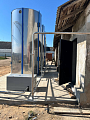
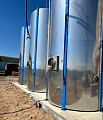

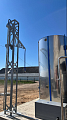
Appointment
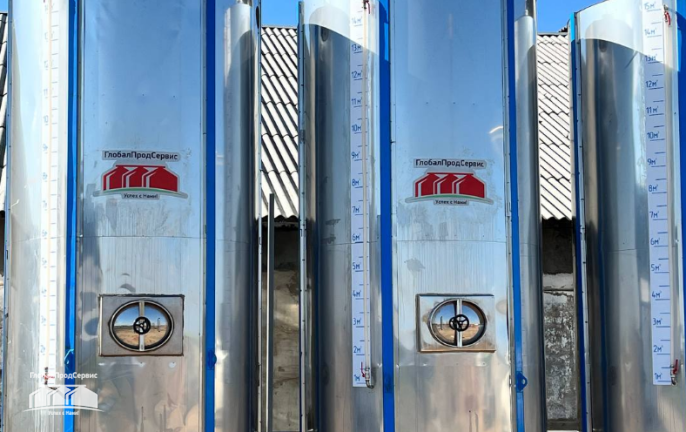
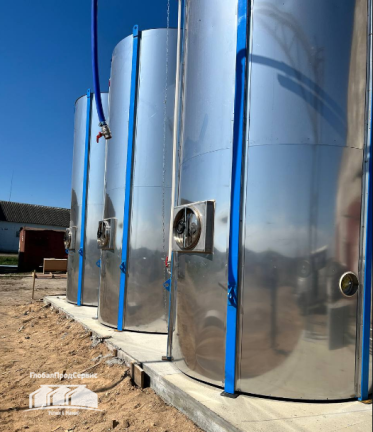
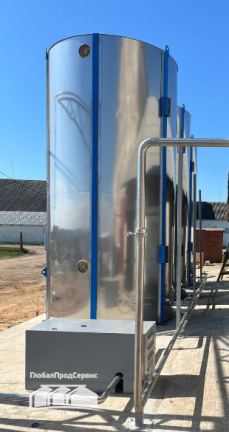
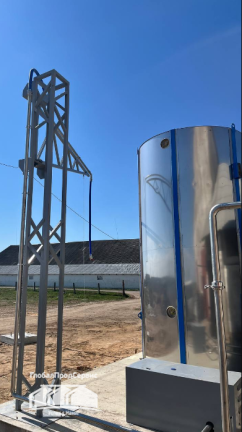
An oil storage tank is a technical device designed for receiving, accumulating, and storing vegetable oils (rapeseed, sunflower, and soy).
Advantages of choosing containers with a volume of 15-20 m3:
- The optimal size is enough to create a stock, but does not require too much space
- Cost-effective - less installation and maintenance costs than for large tanks
- Flexibility of use - suitable for different types of oils and tasks
- Quick installation - installation in 1-2 days without complicated preparation
- Compliance with standards - volumes up to 20 m3 often do not require complex installation permits
Characteristic
- Working volume: 15-20 m3
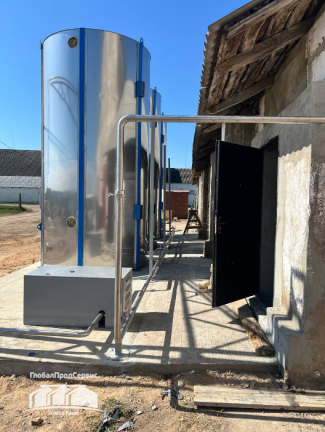
- Orientation: cylindrical vertical tank on supports for stationary operation
- Bottom design: conical, cone angle of at least 250 - ensures complete oil drain without residue
- Material: stainless steel (possible grades: AISI 304, AISI 316, 12X18H10T, 08X18H10T)
- Insulation: container with a heating jacket (thermally insulating "shell" around the body)
- Construction type: all-welded, vertical cylindrical container with a conical bottom and a flat/conical top
Overall dimensions (approximate):
| Parameter | Capacity 15 m3 | Capacity 20 m3 |
| Working volume, m3 |
15 |
20 |
| Height, mm |
3000 - 3500 |
4000 - 4500 |
| Case diameter, mm |
2000 - 2100 |
2200 -2300 |
| Wall thickness, mm |
4,0 - 5,0 |
4,0 - 6,0 |
| Bottom thickness, mm |
5,0 - 6,0 |
5,0 - 7,0 |
| Insulation thickness, mm |
100 - 120 |
100 - 150 |
| Total weight (empty), kg |
1800-2500 |
2450-3200 |
| The mass of the filled container, t | up to 22.5 t (with oil) | up to 22.5 t (with oil) |
The actual dimensions may vary depending on: customer requirements (for example, thicker metal for aggressive environments); type of insulation and jacket design; availability of additional equipment (heating, sensors, filters), standards of materials used.
The foundation must support the full mass of the filled container. This is usually a concrete slab or a ribbon foundation with an anchor attachment.
Installation is carried out only on a flat, hard surface with verticality check (deviation of no more than 1-2 °).
Oil storage tank device:
1. The tank body consists of cylindrical stainless steel shells with a thickness of 4.0–6.0 mm.
2. Around the main tank (where the oil is stored) there is another layer - a kind of "casing" - an INSULATED SHIRT. Its main task is to prevent the temperature inside from changing too much due to the weather: in winter, the oil will not cool down and thicken much, and in summer it will overheat. There is a free space — a cavity - between the wall of the container and this outer casing. This void is filled with a layer of insulation that does not pass heat well - mineral wool, a dense, fibrous material, the thickness of the insulation is from 100 to 150 mm. This is enough to reliably protect the contents from the cold in winter and from the heat in summer.
From above, this entire "sandwich" (container + cavity with insulation) is covered with another layer of galvanized steel 0.5–1.0 mm thick. It is needed to: protect the insulation from rain, snow, wind and mechanical damage (for example, if someone accidentally touches the container), prevent the steel from rusting - galvanizing creates a protective layer against corrosion, give the structure a neat appearance and make it stronger.
An insulated shirt provides several important advantages:
- the oil does not thicken in the cold - it is easier to pump and use.
- the oil does not overheat in the heat — its properties are preserved.
- reduced heating costs. If there were no shirt, you would have to heat the oil separately in winter, which is an energy expense.
- the capacity lasts longer. Protection against sudden changes in temperature and moisture reduces material wear.
- it is convenient to store oil in any conditions - outdoors in winter, in an unheated room, in regions with a harsh climate.
3. Supports: the container is based on 4 steel channel supports and has holes for fixing to the floor using M20 anchor bolts. The container has welded and flanged connections, as well as eyelets for easy movement of the container during installation.
4. Hatches, pipes and flanges, service area.
5. Additional equipment (optional):
level sensors (float, capacitive);
thermometers and temperature sensors;
sampling devices;
level sensors (float, capacitive);
thermometers and temperature sensors;
sampling devices;
electric heating
The principle of operation
The tanks receive oil through the inlet pipes, distribute it over the volume and store it under specified conditions (temperature, pressure, tightness). Liquid level monitoring is carried out using level meters and alarms. Vegetable oil is supplied to the tank by a pump, taken up by a pump. To maintain the required temperature of the working medium, the tanks can be equipped with heat exchange devices (jackets) or electric heating systems based on a heating cable.
Storage equipment is an integral part of technological lines for processing oilseeds and the production of vegetable oils. The complex lines include a large number of other equipment that performs its own technological operations.
Advantages of oil storage tanks
- Complete tightness: The welds are checked for tightness
- Corrosion resistance: stainless steel does not interact with oils, does not rust
- Thermal stability: insulation reduces heat loss, prevents oil from thickening at low temperatures
- Durability: The service life is 20-30 years with proper maintenance
- Warranty: 24 months
MANUFACTURER: Globalprodservice
An oil storage tank is a technical device designed for receiving, accumulating, and storing vegetable oils (rapeseed, sunflower, and soy).
Advantages of choosing containers with a volume of 15-20 m3:
- The optimal size is enough to create a stock, but does not require too much space
- Cost-effective - less installation and maintenance costs than for large tanks
- Flexibility of use - suitable for different types of oils and tasks
- Quick installation - installation in 1-2 days without complicated preparation
- Compliance with standards - volumes up to 20 m3 often do not require complex installation permits
- Working volume: 15-20 m3
- Orientation: cylindrical vertical tank on supports for stationary operation
- Bottom design: conical, cone angle of at least 250 - ensures complete oil drain without residue
- Material: stainless steel (possible grades: AISI 304, AISI 316, 12X18H10T, 08X18H10T)
- Insulation: container with a heating jacket (thermally insulating "shell" around the body)
- Construction type: all-welded, vertical cylindrical container with a conical bottom and a flat/conical top
Overall dimensions (approximate):
| Parameter | Capacity 15 m3 | Capacity 20 m3 |
| Working volume, m3 |
15 |
20 |
| Height, mm |
3000 - 3500 |
4000 - 4500 |
| Case diameter, mm |
2000 - 2100 |
2200 -2300 |
| Wall thickness, mm |
4,0 - 5,0 |
4,0 - 6,0 |
| Bottom thickness, mm |
5,0 - 6,0 |
5,0 - 7,0 |
| Insulation thickness, mm |
100 - 120 |
100 - 150 |
| Total weight (empty), kg |
1800-2500 |
2450-3200 |
| The mass of the filled container, t | up to 22.5 t (with oil) | up to 22.5 t (with oil) |
The actual dimensions may vary depending on: customer requirements (for example, thicker metal for aggressive environments); type of insulation and jacket design; availability of additional equipment (heating, sensors, filters), standards of materials used.
The foundation must support the full mass of the filled container. This is usually a concrete slab or a ribbon foundation with an anchor attachment.
Installation is carried out only on a flat, hard surface with verticality check (deviation of no more than 1-2 °).
Oil storage tank device:
1. The tank body consists of cylindrical stainless steel shells with a thickness of 4.0–6.0 mm.
2. Around the main tank (where the oil is stored) there is another layer - a kind of "casing" - an INSULATED SHIRT. Its main task is to prevent the temperature inside from changing too much due to the weather: in winter, the oil will not cool down and thicken much, and in summer it will overheat. There is a free space — a cavity - between the wall of the container and this outer casing. This void is filled with a layer of insulation that does not pass heat well - mineral wool, a dense, fibrous material, the thickness of the insulation is from 100 to 150 mm. This is enough to reliably protect the contents from the cold in winter and from the heat in summer.
From above, this entire "sandwich" (container + cavity with insulation) is covered with another layer of galvanized steel 0.5–1.0 mm thick. It is needed to: protect the insulation from rain, snow, wind and mechanical damage (for example, if someone accidentally touches the container), prevent the steel from rusting - galvanizing creates a protective layer against corrosion, give the structure a neat appearance and make it stronger.
An insulated shirt provides several important advantages:
- the oil does not thicken in the cold - it is easier to pump and use.
- the oil does not overheat in the heat — its properties are preserved.
- reduced heating costs. If there were no shirt, you would have to heat the oil separately in winter, which is an energy expense.
- the capacity lasts longer. Protection against sudden changes in temperature and moisture reduces material wear.
- it is convenient to store oil in any conditions - outdoors in winter, in an unheated room, in regions with a harsh climate.
3. Supports: the container is based on 4 steel channel supports and has holes for fixing to the floor using M20 anchor bolts. The container has welded and flanged connections, as well as eyelets for easy movement of the container during installation.
4. Hatches, pipes and flanges, service area.
5. Additional equipment (optional):
level sensors (float, capacitive);
thermometers and temperature sensors;
sampling devices;
level sensors (float, capacitive);
thermometers and temperature sensors;
sampling devices;
electric heating
The tanks receive oil through the inlet pipes, distribute it over the volume and store it under specified conditions (temperature, pressure, tightness). Liquid level monitoring is carried out using level meters and alarms. Vegetable oil is supplied to the tank by a pump, taken up by a pump. To maintain the required temperature of the working medium, the tanks can be equipped with heat exchange devices (jackets) or electric heating systems based on a heating cable.
Storage equipment is an integral part of technological lines for processing oilseeds and the production of vegetable oils. The complex lines include a large number of other equipment that performs its own technological operations.
- Complete tightness: The welds are checked for tightness
- Corrosion resistance: stainless steel does not interact with oils, does not rust
- Thermal stability: insulation reduces heat loss, prevents oil from thickening at low temperatures
- Durability: The service life is 20-30 years with proper maintenance
- Warranty: 24 months
MANUFACTURER: Globalprodservice
Advantages of the equipment

Robust construction

Stable and reliable production

Maximum efficiency

Easy to operate

Easy maintenance

It will save space

Low maintenance costs

Long service life